
Therapist?Try Klarify
Mental health insights and practical resources published on Klarify.
A good therapist should always make you feel supported and understood, so if they challenge you or say something that lands hard, something must be wrong. That's the misconception. In reality, therapeutic challenge within a safe…
Trauma shows up in ways that don't match the textbook. You might never have flashbacks or nightmares but still feel the weight of what happened in how you move through relationships, how your body reacts to stress, or how hard it is to…

One of the most persistent misconceptions about therapy is that you have to excavate your childhood to get anywhere. In reality, effective therapy meets you where you are: some approaches focus almost entirely on the present moment and…
Trauma shows up in ways most people don't recognize: the person who can't make decisions without checking in three times, the one who apologizes for taking up space, the body that tenses every time a door slams. Many of my clients arrive…
Hopelessness doesn't mean you've stopped trying or that you're weak. It's often a sign that you've been trying too hard for too long without the right support, and your nervous system is exhausted. The feeling isn't a character flaw; it's…
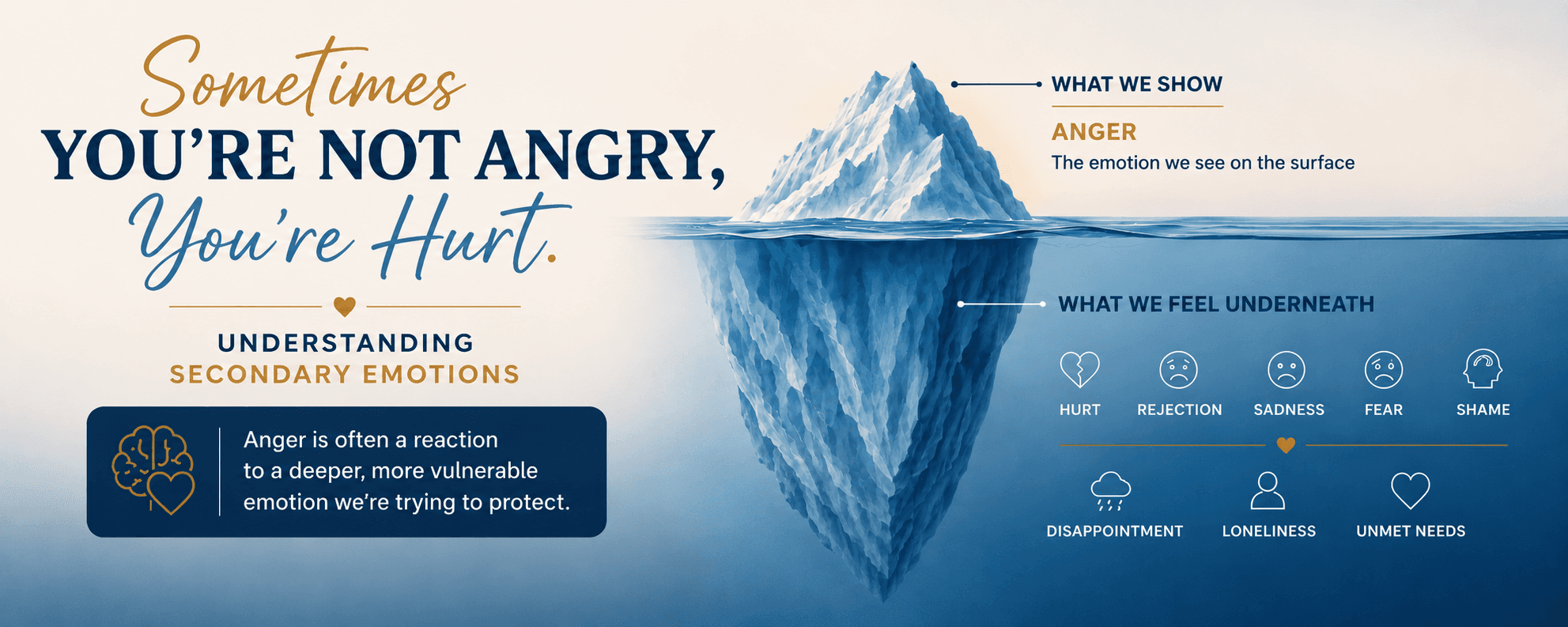
Sometimes You're Not Angry… You're Hurt: Understanding Secondary Emotions You snap at your partner over something small. You go cold and quiet after a friend cancels plans. You feel your jaw tighten when your boss takes credit for your…

Many people associate anxiety with panic attacks, social avoidance, or feeling overwhelmed. However, anxiety can manifest in other forms. Individuals with high-functioning anxiety often appear calm, successful, and capable. They meet…
ADHD doesn't just scatter your attention or make deadlines slip. It also turns your internal fairness alarm up so high that small injustices can feel like moral emergencies, triggering a cascade of anger, rumination, and an urgent need to…
High-functioning anxiety describes people who meet their responsibilities and appear successful while experiencing persistent internal worry, perfectionism, and exhaustion that others rarely see. They show up on time, hit deadlines, and…
High-functioning anxiety describes people who meet their responsibilities and appear successful on the outside while experiencing chronic internal worry, perfectionism, and exhaustion. They rarely miss work, maintain relationships, and…
Trauma isn't always a single catastrophic event. In my work with adults and adolescents, I see people carrying the weight of experiences that felt too small to name as trauma but left lasting marks: chronic criticism, emotional neglect,…
High-functioning anxiety describes people who meet every deadline, answer every email, and show up on time while wrestling with constant internal worry that no one else sees. They appear successful and organized on the outside, but…

You Have More Rights in Therapy Than You Think Walking into a therapist's office — or logging on for a virtual session — can feel vulnerable. You might wonder: Am I allowed to push back? Can I change direction? What if this isn't working?…

Self-gaslighting is the habit of dismissing, minimizing, or rewriting your own experience to align with someone else's version of reality. It often starts as a survival strategy in relationships where doubting yourself felt safer than…

You're Not Lazy. Here's What's Actually Happening When You Can't Start. You know the feeling. There's something on your to-do list — something that genuinely matters to you — and yet you've been scrolling on your phone for an hour. The…

If you've ever told yourself to "just be kinder to yourself" and found that advice landing somewhere between hollow and maddening, you're not alone. When you're in the thick of depression, self-compassion can sound like something your…

The Gap Between Knowing and Doing Most people who come to therapy already know what would help them feel better — exercise more, set boundaries, stop catastrophizing — but can't seem to do it. The gap isn't knowledge. It's the space…

A trauma-informed and neurodiversity-affirming look at protective beliefs and psychological flexibility Why Are Old Beliefs So Hard to Change? A trauma-informed and neurodiversity-affirming look at protective beliefs and psychological…

The myth that therapy means you hand over the wheel! When people imagine therapy, many picture a therapist who directs the client where to go. In reality, good therapy works more like learning to drive with someone in the passenger seat:…

When someone tells me they've been masking for years and "doing fine," I've learned to listen for what that phrase actually means. Masking—suppressing neurodivergent traits, scripting social responses, performing neurotypical…

Working with neurodivergent adults in North York has shown me that self-blame isn't a character flaw but an adaptive response learned early, often before diagnosis. The people I sit with carry a chronic belief that they are the problem,…
ADHD is not a deficit of attention but a difficulty directing it, especially toward tasks that feel unrewarding or abstract. The disorder affects executive function, emotional regulation, working memory, and impulse control, all of which…

Adults with ADHD often develop sophisticated masking strategies over decades, presenting as high-functioning while privately struggling with executive function, emotional regulation, and exhaustion from constant compensation. The gap…

Many autistic adults I work with describe a persistent fear that colleagues will discover they're "performing" neurotypical behavior rather than being authentic. This isn't impostor syndrome in the usual sense; it's the exhausting…