
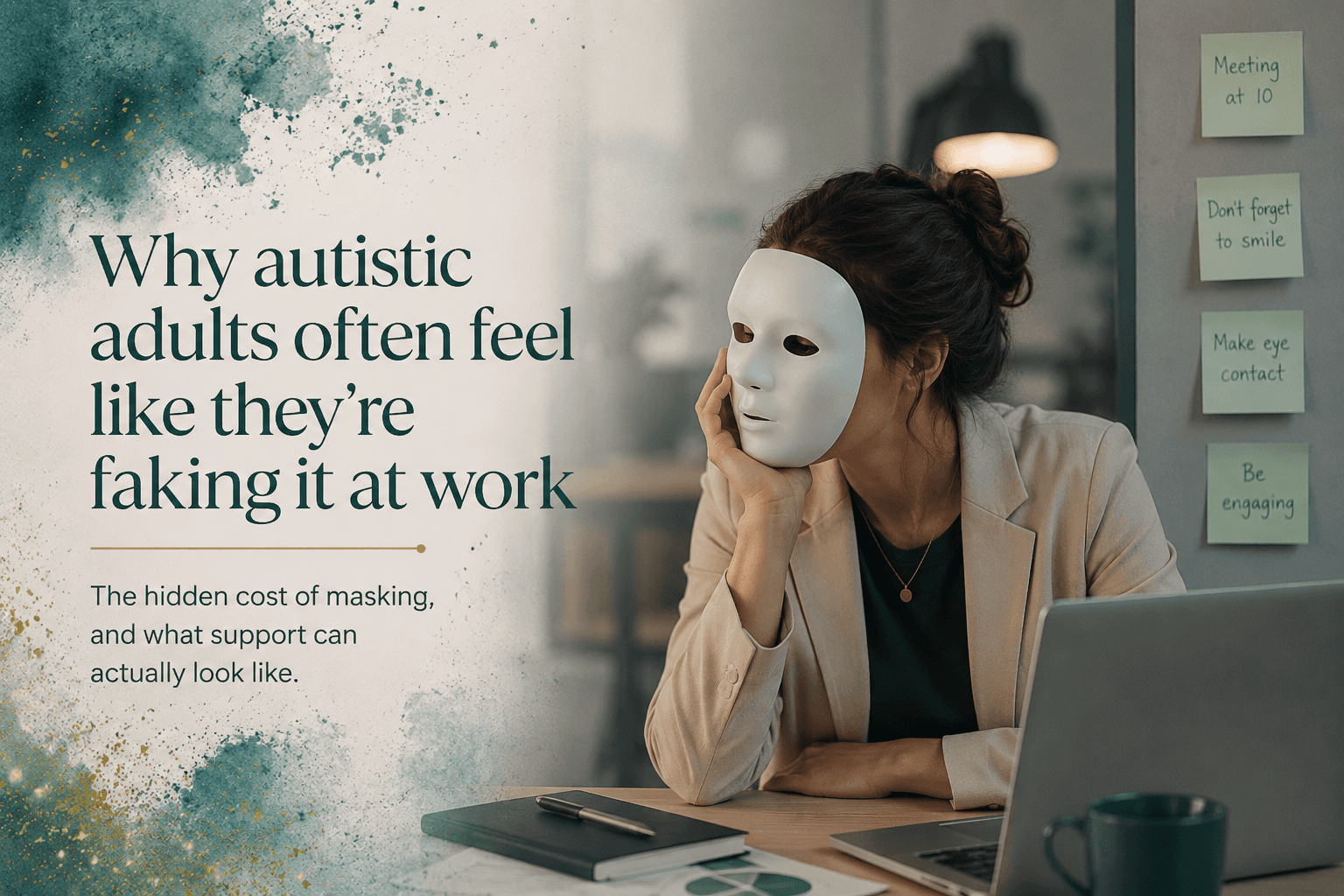
Why Autistic Adults Often Feel Like They're "Faking It" at Work
Many autistic adults I work with describe a persistent fear that colleagues will discover they're "performing" neurotypical behavior rather than being authentic. This isn't impostor syndrome in the usual sense; it's the exhausting awareness that social fluency at work often requires deliberate, effortful translation of unwritten rules that others seem to absorb without thinking.
The term for this is masking, and it's one of the most common reasons autistic adults seek therapy in their twenties and thirties. They've spent years succeeding by conventional measures (stable job, good performance reviews, friendships that look fine from the outside) but feel hollowed out by the effort it takes to maintain that success. The question I hear most often isn't "Am I autistic?" but "If I've managed this long, does it even matter?"
It matters because the cost compounds. Masking isn't a neutral skill you develop and then deploy effortlessly. It's an active cognitive load that accumulates across a workday, a work week, a career. The adults I sit with describe getting home and being unable to speak, cook, or make simple decisions because the day's social navigation drained every reserve. They describe weekends spent recovering rather than living. They describe promotions they turned down because managing a team would require even more real-time translation of tone, subtext, and unspoken expectations.
What masking actually looks like in a professional setting
Masking isn't about lying or pretending to be someone else. It's about manually running processes that happen automatically for most neurotypical people. In my work with autistic adults, I see it show up as rehearsing small talk before a meeting, scripting responses to "How was your weekend?", monitoring your own facial expressions in video calls, and tracking how long you've been talking to avoid the moment when someone's attention visibly drifts.
One pattern I notice across clients is the amount of energy spent on eye contact. Neurotypical people modulate eye contact without thinking; autistic people often describe it as either uncomfortable (maintaining it) or risky (not maintaining it, and being read as disengaged or untrustworthy). The same applies to vocal prosody: matching the enthusiasm level your manager expects in a standup, even when you're genuinely excited about the work but your natural affect doesn't broadcast that excitement in the expected register.
The ASHA's 2023 review of autism and communication emphasizes that these differences aren't deficits; they're variations in how people process and express social information. But workplaces aren't built around variation. They're built around a narrow bandwidth of "professional" behavior, and people outside that bandwidth pay a tax to participate.
The specific toll of open-plan offices and "collaborative" culture
The shift toward open offices and always-on collaboration hits autistic employees disproportionately hard. Neurotypical people also find open plans draining, but for autistic adults the sensory and social load often crosses from uncomfortable into unsustainable. Fluorescent lights, overlapping conversations, the unpredictability of when someone will walk up to your desk: these aren't minor annoyances. They're constant low-grade stressors that prevent the kind of deep focus many autistic people excel at when the environment supports it.
I work with software developers, analysts, and designers who describe being most productive in the two hours before anyone else arrives or the hour after everyone leaves. The work itself isn't the problem. The environment is. But asking for accommodations (noise-canceling headphones, permission to work from home more often, a desk away from high-traffic areas) requires disclosing something many people aren't ready to name, especially if they only recently realized the lens of autism applies to them.
The rhetoric around "collaboration" and "team culture" makes this harder. If your manager frames constant availability and spontaneous brainstorming as core values, asking to work differently feels like asking to be a bad team member. The adults I see often describe waiting years to request accommodations because they believed needing them meant they weren't cut out for the role.
Why diagnosis in adulthood is both clarifying and destabilizing
Roughly half the autistic adults I work with come to therapy after a recent diagnosis or self-identification. The other half come because they suspect autism applies to them but aren't sure, or aren't sure it matters. Both groups describe the same relief-and-grief mix: relief that there's a coherent explanation for decades of feeling slightly out of step, and grief over the years spent believing they were uniquely bad at being a person.
Late diagnosis often follows a crisis. Burnout is the most common precipitant I see. Someone who's been masking successfully for years hits a point where the strategies stop working: a job change, a breakup, a pandemic that removes the structure they relied on. The system that held them together stops holding, and the question "What's wrong with me?" becomes urgent in a way it wasn't before.
Diagnosis doesn't fix that, but it does reframe it. The problem isn't that you're broken. The problem is that you've been running an unsustainable adaptation for years, and the bill came due. Therapy after diagnosis is less about learning to mask better and more about figuring out which parts of masking you can stop doing, which accommodations you can ask for, and how to rebuild a life that doesn't require performing neurotypicality eight hours a day.
What actually helps (and what doesn't)
The least helpful advice I see autistic adults receive is some version of "just be yourself." That advice assumes the environment is neutral and the problem is internal confidence. But most workplaces aren't neutral. They reward a specific presentation style, communication style, and social style, and people outside that range face real consequences (fewer promotions, lower performance ratings, being labeled "difficult" or "not a culture fit").
What helps more is identifying which aspects of masking are protecting you from real professional harm and which are protecting you from imagined judgment. Some clients realize they've been masking in ways no one actually cares about: no one notices if you don't make eye contact during a Zoom call, no one tracks whether you laughed at the right moment in a meeting. Other clients realize the opposite: their manager does penalize them for communication differences, and the job might not be salvageable without either disclosure or a different role.
The accommodations that make the biggest difference are often small and logistical. A desk facing a wall instead of foot traffic. Permission to send a written summary instead of talking through ideas in real time. A standing agreement that "I need to think about that" is an acceptable response in meetings, not a sign of disengagement. None of these require a formal diagnosis, though having one makes the request easier to frame as a legal accommodation rather than a personal preference.
Therapy helps most when it's focused on decision-making rather than symptom reduction. The question isn't "How do I stop being autistic at work?" It's "Which parts of this job are worth the effort, and which parts are grinding me down for no good reason?"
Citations
1. Autism and Communication Skills: Addressing Misconceptions With Scientific Facts (ASHA, 2023)
Frequently asked questions
Do I need a formal diagnosis to access accommodations at work?
No, though it makes the process clearer. Under Canadian human rights law, you're entitled to accommodations based on disability, and autism qualifies whether or not you have formal paperwork.
That said, a diagnosis from a psychologist or psychiatrist gives you documentation if your employer pushes back or if you need to escalate to HR. Some people pursue diagnosis purely for that reason. Others find that describing their needs in plain language ("I work better with written instructions", "I need advance notice for meeting topics") gets them what they need without disclosure.
Can you develop better social skills through therapy, or is masking the only option?
You can absolutely develop skills, but the frame matters. Therapy that treats autistic communication as a deficit to fix usually backfires. What works better is learning to translate between your natural communication style and the style your workplace expects, while also identifying environments where less translation is required.
Some of the adults I work with get better at reading social cues through explicit instruction: learning that a certain tone signals frustration, that a long pause often means the other person wants you to stop talking. Others decide that expending energy on those skills isn't worth it and focus instead on finding roles where their natural communication style is less of a mismatch. Both are valid. The goal isn't to become neurotypical; it's to reduce the friction between who you are and how you need to show up.
Is it common for autistic adults to also have ADHD, anxiety, or depression?
Yes, co-occurrence is the norm rather than the exception. Studies suggest that 50 to 70 percent of autistic adults also meet criteria for ADHD, and anxiety and depression rates are significantly higher than in the general population.
In my work, I see anxiety and depression most often as downstream effects of years of masking and misattribution. People spend decades believing they're failing at something everyone else finds easy, which is a reliable recipe for both. ADHD complicates the picture because the executive function challenges overlap with autism in some areas (task initiation, working memory) and diverge in others (hyperactivity, impulsivity). Sorting out which symptoms come from which condition matters for treatment, but the larger point is that none of these exist in isolation. Addressing one without the others rarely works.
How do I know if I'm autistic or just introverted, anxious, or socially awkward?
The distinction is pattern and pervasiveness. Introversion is about energy: social interaction drains you, solitude restores you. Autism is about translation: social interaction requires active interpretation of rules and cues that others seem to absorb automatically, regardless of whether the interaction itself is energizing or draining.
Social anxiety is about fear of judgment; autism is about difficulty predicting what will be judged. Autistic people can also be anxious, introverted, or awkward, so the categories overlap. But if you've spent your whole life feeling like you're reading from a script everyone else was born knowing, if you have intense focused interests that others find disproportionate, if you're highly sensitive to sensory input (lights, sounds, textures), and if these patterns were present in childhood even if you learned to adapt, autism is worth exploring. A formal assessment can clarify, but self-identification is valid too. Many of the adults I work with find that the lens alone, whether or not they pursue diagnosis, is enough to make their experience make sense.