
Sometimes You're Not Angry… You're Hurt
Sometimes You're Not Angry… You're Hurt: Understanding Secondary Emotions
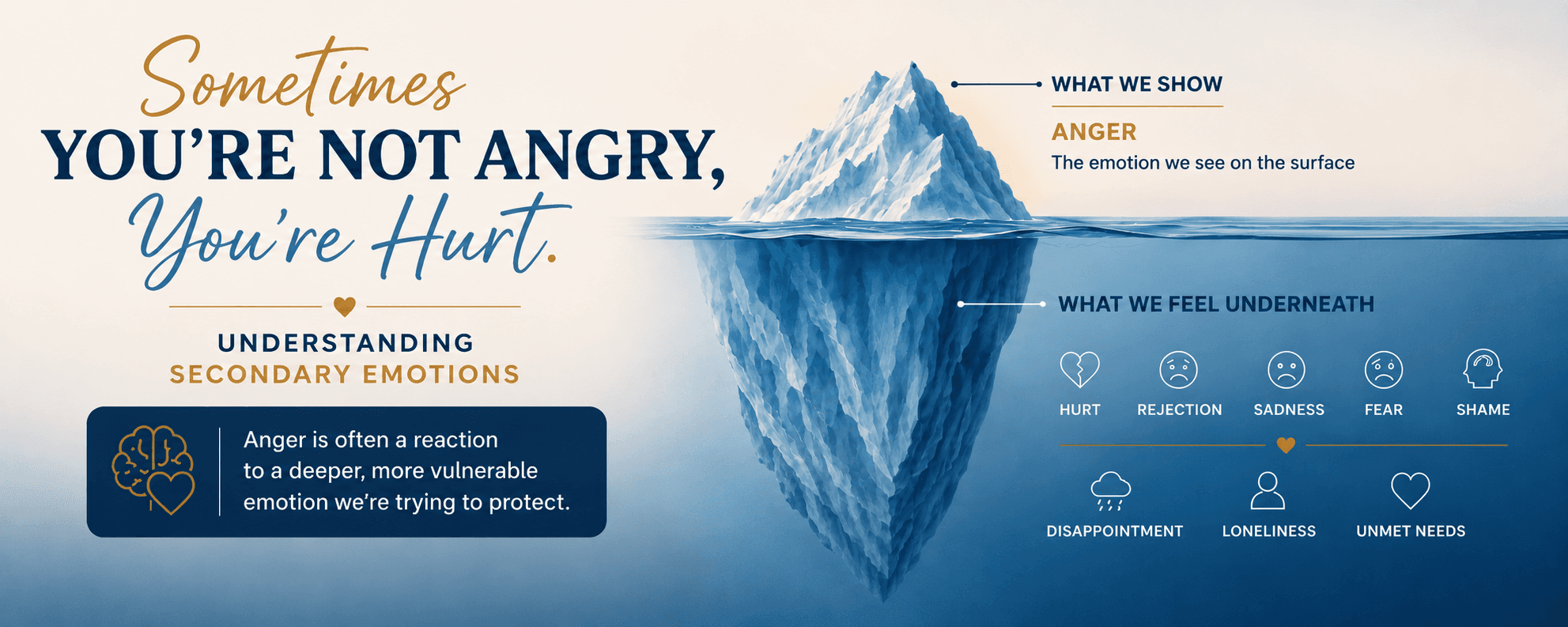
You snap at your partner over something small. You go cold and quiet after a friend cancels plans. You feel your jaw tighten when your boss takes credit for your work. We call all of these moments "anger" — but anger isn't always the whole story. Underneath it, often just out of reach, is something softer and more vulnerable: hurt, fear, shame, loneliness, or the ache of feeling unseen. Understanding the difference can change how you relate to yourself and the people around you.
Key takeaways
Anger is often a secondary emotion — a protective layer over something more vulnerable underneath.
Primary emotions like hurt, fear, shame, and loneliness can feel too exposed, so the brain reaches for anger instead.
This happens automatically and isn't a character flaw — it's a protective instinct.
Learning to pause and ask "what am I really feeling?" is a skill that improves with practice.
Therapy can help you identify your emotional patterns and communicate in ways that actually bring people closer.
What is a secondary emotion?
Emotions can be layered. A primary emotion is the raw, immediate feeling that arises first — the one that's closest to the truth of what's happening inside you. A secondary emotion is the feeling that shows up on top of it, often as a way of coping with or protecting yourself from the primary one.
Anger is one of the most common secondary emotions. It arrives quickly, it feels powerful, and — crucially — it points outward. When you're angry, the focus shifts to what someone else did wrong. That can feel a lot safer than sitting with the quieter, more exposed feeling underneath: I'm hurt. I'm scared. I feel like I don't matter.
This isn't a conscious choice. Your brain isn't plotting to hide your feelings from you. It's doing what it's always done — trying to protect you.
Why anger feels safer than vulnerability
Vulnerability requires you to acknowledge that something got to you — that you care, that you were affected, that you needed something and didn't get it. For many people, that kind of openness feels dangerous. It can bring up old experiences of being dismissed, laughed at, or hurt when they showed their softer side.
Anger, by contrast, creates distance. It builds a wall. It signals strength rather than need. And in the short term, it works — it keeps the vulnerable feeling at bay and gives you somewhere to put all that energy.
The problem is that anger, when it's standing in for something else, rarely resolves the thing that actually needs resolving. You can win the argument and still feel completely alone. You can stay furious for days and never get any closer to feeling understood.
What's really underneath: everyday examples
In romantic relationships
Your partner forgets something that mattered to you — a date, a promise, a detail you mentioned more than once. You feel a flash of anger. Maybe you go quiet, or maybe you say something sharp. But underneath the anger is something harder to say out loud: I don't feel like a priority to you. I'm afraid I care more about this relationship than you do.
Anger is easier to express than that. But it's also much harder for your partner to respond to. When you lead with anger, they get defensive. When you find a way to say "I felt hurt and a little scared," the conversation has somewhere to go.
In family conflict
A parent makes a comment about your choices — your job, your parenting, your lifestyle. You feel a surge of irritation, maybe even rage. You snap back or stew for hours. But the primary emotion is often something older and more tender: I still want your approval. I'm afraid you're disappointed in me. I've never felt like enough in this family.
Family relationships carry so much history. Anger can be a way of protecting yourself from feelings that go back decades — feelings you may not even have words for yet.
In friendships
A close friend keeps canceling on you, or seems distracted every time you talk, or forgets to check in after something hard you went through. You tell yourself you're fine, then realize you're quietly furious. The anger is real — but underneath it is loneliness, and the fear that maybe this friendship doesn't mean as much to them as it does to you.
Friendships are rarely talked about with the same seriousness as romantic relationships, which means the hurt that happens in them often goes unnamed. Anger fills that gap.
In the workplace
Your manager takes credit for your idea in a meeting. A colleague gets the promotion you were counting on. You're asked to take on more work with no acknowledgment of what you're already carrying. The anger is immediate and feels completely justified — and it may well be. But underneath it is often something more vulnerable: I feel invisible here. I work hard and it doesn't seem to matter. I'm starting to wonder if I'm valued at all.
In professional settings, vulnerability feels especially risky, which makes anger an even more common stand-in for the feelings that are actually driving the distress.
How to pause and ask: "What am I really feeling?"
This is a skill, not a switch. You won't do it perfectly the first time, or the tenth. But with practice, the pause between the trigger and the reaction gets a little longer — and in that pause, there's room to get curious.
Step 1: Notice the anger without acting on it immediately
When you feel anger rising, try to name it to yourself before you do anything else. I'm angry right now. That's it. You don't have to fix it or express it yet. Just notice it. This small act of naming creates a tiny bit of distance between the feeling and your response.
Step 2: Get curious about what's underneath
Ask yourself: If I weren't angry right now, what would I be feeling? Or: What did that moment mean to me? What did it touch? Some common primary emotions hiding under anger include:
Hurt — something someone did or said caused you pain
Fear — you're worried about losing something or someone important
Shame — you feel embarrassed, exposed, or like you've fallen short
Rejection — you feel pushed away or like you don't belong
Loneliness — you feel unseen, unheard, or disconnected
Disappointment — something you hoped for didn't happen
Feeling unheard — your needs or perspective weren't acknowledged
Step 3: Name the primary emotion to yourself
You don't have to share it with anyone yet. Just try saying it internally: I'm not just angry. I'm hurt. I feel rejected. I'm scared. Notice what happens in your body when you do. For many people, naming the real feeling brings a small sense of relief — even if it also brings tears.
Step 4: Decide how you want to respond
Once you know what you're actually feeling, you have more choices. You might decide to share it with the person involved: "I wasn't just annoyed — I actually felt really hurt by that." You might decide to write it down first. You might decide to wait until you're calmer. The point is that you're responding to the real feeling, not just the protective layer on top of it.
Step 5: Be patient with yourself
This process takes time. Some people have spent years — or a lifetime — using anger as a shield. Unlearning that pattern doesn't happen overnight. What matters is that you keep getting curious, keep asking the question, and keep giving yourself permission to feel the softer things.
How therapy can help
One of the most valuable things therapy offers is a safe place to feel the feelings you've been protecting yourself from. When you've spent a long time leading with anger, the emotions underneath can feel overwhelming or unfamiliar. A therapist can help you approach them at a pace that feels manageable.
Therapy can also help you identify your specific emotional patterns — the particular triggers that reliably send you into anger, the relationships where it happens most, and the early experiences that may have taught you that vulnerability wasn't safe. Understanding those patterns doesn't just help you feel better; it changes how you show up in your relationships.
Many people find that as they get better at identifying and expressing their primary emotions, their relationships shift. Conversations that used to end in arguments start ending in connection. People feel less alone. The anger doesn't disappear — but it stops running the show.
Frequently asked questions
Is anger ever the primary emotion?
Yes. Anger can absolutely be a primary emotion — a direct, immediate response to something genuinely threatening, unjust, or harmful. The distinction isn't always clear-cut, and you don't need to second-guess every moment of anger you feel. The question worth asking is simply: Is there something else here too? Sometimes the answer is no. Often, there's more.
What if I don't know what I'm feeling underneath the anger?
That's very common, especially if you grew up in an environment where certain emotions weren't safe to express or weren't modeled by the adults around you. Start small — just notice where you feel the anger in your body, and whether there's any other physical sensation alongside it. A tightness in the chest might be fear. A heaviness might be sadness. The body often knows before the mind does.
What if sharing my vulnerable feelings makes things worse?
It's a fair concern. Not every relationship is a safe place for vulnerability, and not every moment is the right moment. Learning to identify your primary emotions doesn't mean you have to share them with everyone. It means you understand yourself better — and from that place, you can make more intentional choices about when and with whom to open up.
Can this pattern be related to childhood experiences?
Often, yes. Many people learned early on that showing hurt, fear, or sadness led to being dismissed, punished, or taken advantage of. Anger felt safer — and that lesson stuck. Recognizing where the pattern came from isn't about blame; it's about understanding yourself with more compassion.
If you find yourself stuck in cycles of anger that leave you feeling disconnected from the people you care about, therapy can help you find your way back to what's underneath — and to the relationships that become possible when you get there. You don't have to keep protecting yourself from your own feelings.